

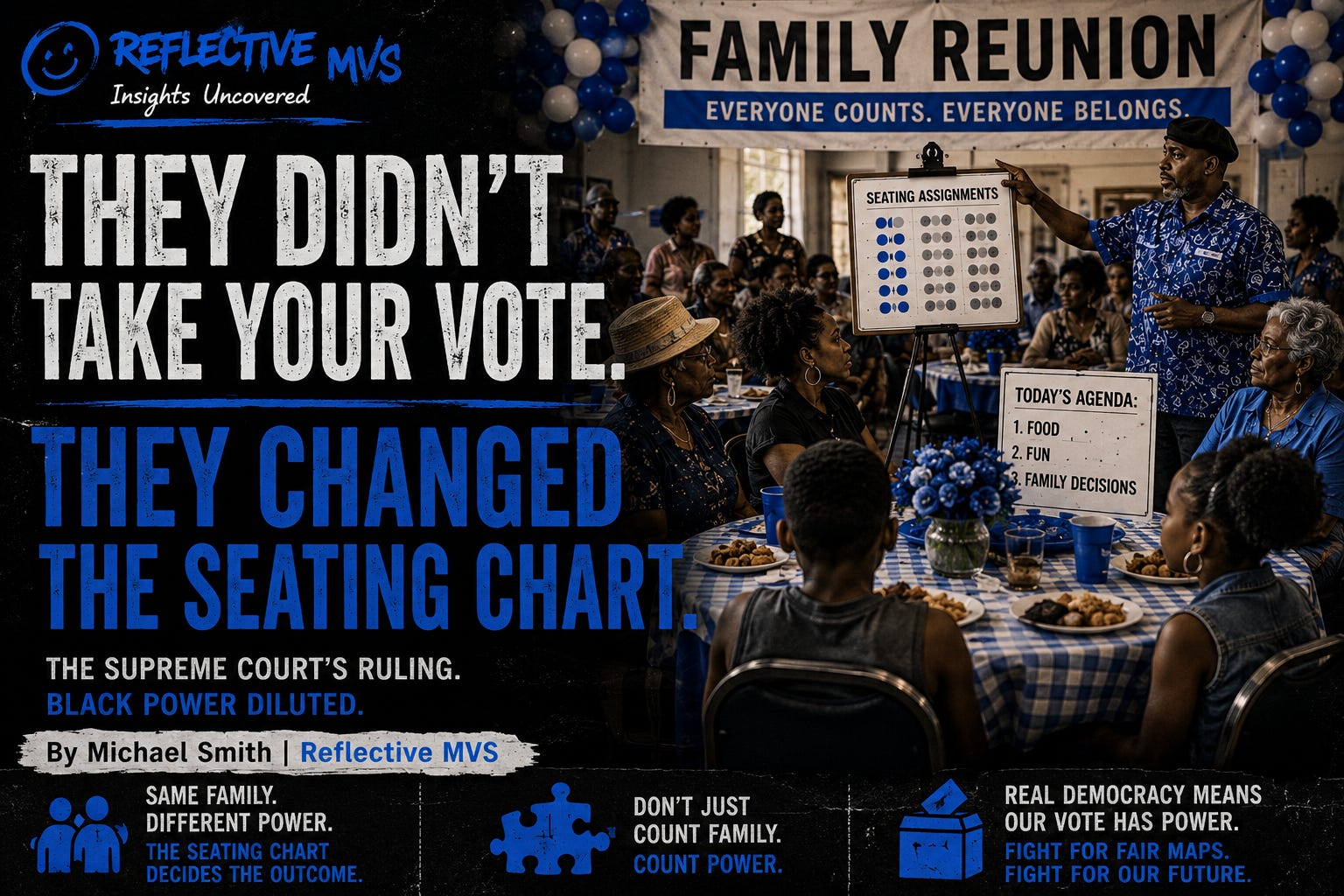
They Didn’t Take Your Vote.
They Changed the Seating Chart.

By Michael Smith | Reflective MVS
Imagine you are at a family reunion.
Everybody paid dues. Everybody brought a dish. Somebody’s auntie made potato salad that needs an investigation, but we are not here for that today.
At the end of the reunion, the family has to vote on how to spend the money left over.
Your side of the family wants to fix Grandma’s porch. The steps are loose. The railing is shaky. Everybody knows it needs to be done.
Your side has enough people to win at least one real seat at the decision table.
But before the vote happens, the person in charge of the seating chart gets clever.
They split your side up.
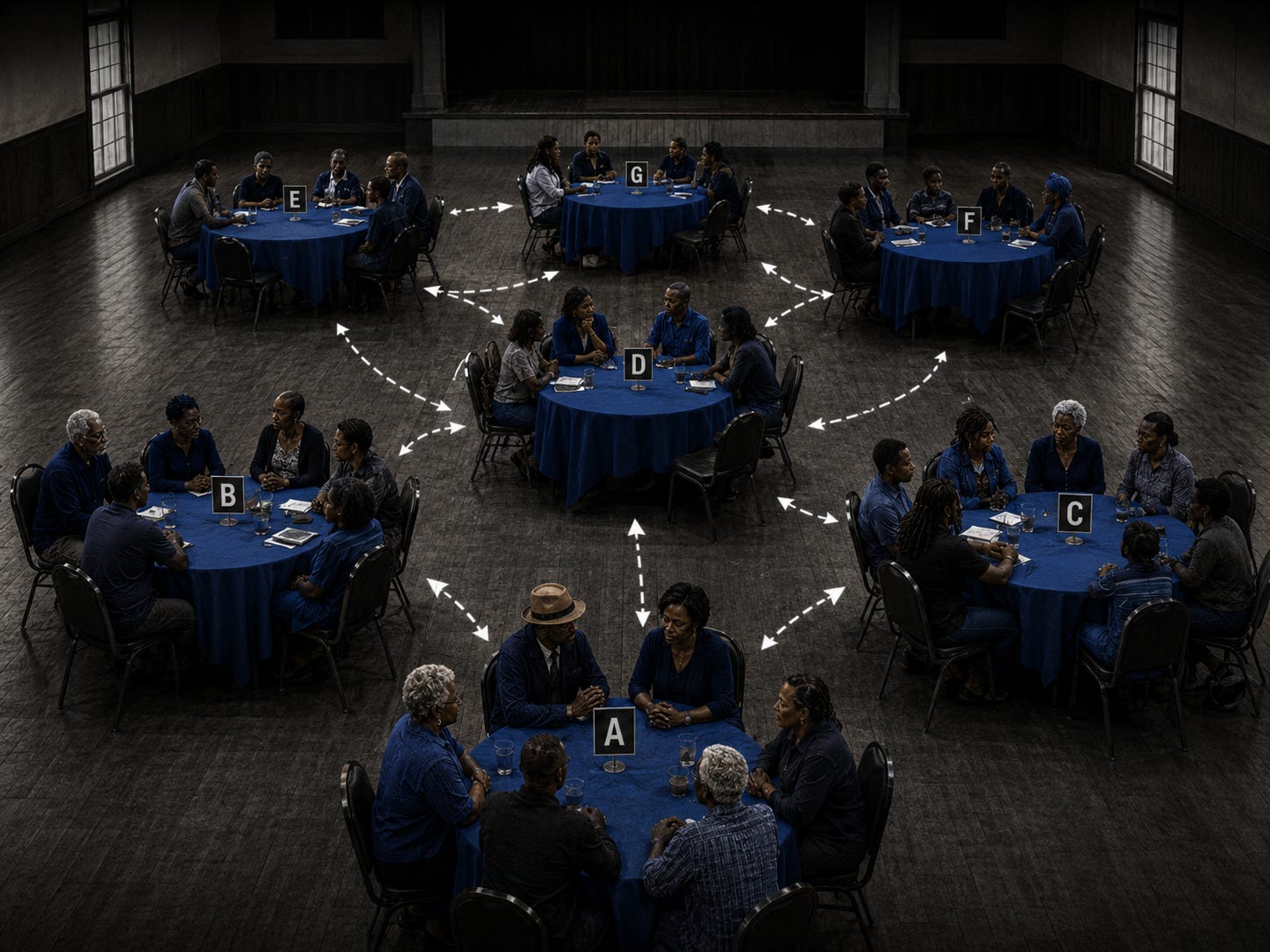
A few of you are put at Table A.
A few more at Table C.
Some cousins are moved to the back.
A few elders get seated with people who do not even know Grandma’s porch is broken.
Now every table gets to vote.
Nobody banned you.
Nobody took the ballot out of your hand.
Nobody said you were not family.
But your people have been scattered so badly that your issue loses at every table.
Then the person holding the clipboard smiles and says, “See? Everybody had a voice.”
That is not fairness.
That is a rigged seating chart.
And that is the easiest way to understand what the Supreme Court just did to Black voting power.
In Louisiana v. Callais, the Supreme Court struck down Louisiana’s congressional map that had created two majority-Black districts after years of litigation over whether Black voters were being fairly represented. The NAACP Legal Defense Fund described the ruling as one that “gutted Section 2” of the Voting Rights Act, one of the last major federal tools used to challenge discriminatory maps.
That may sound like legal background noise.
It is not.
This is about who gets a real seat at the table.
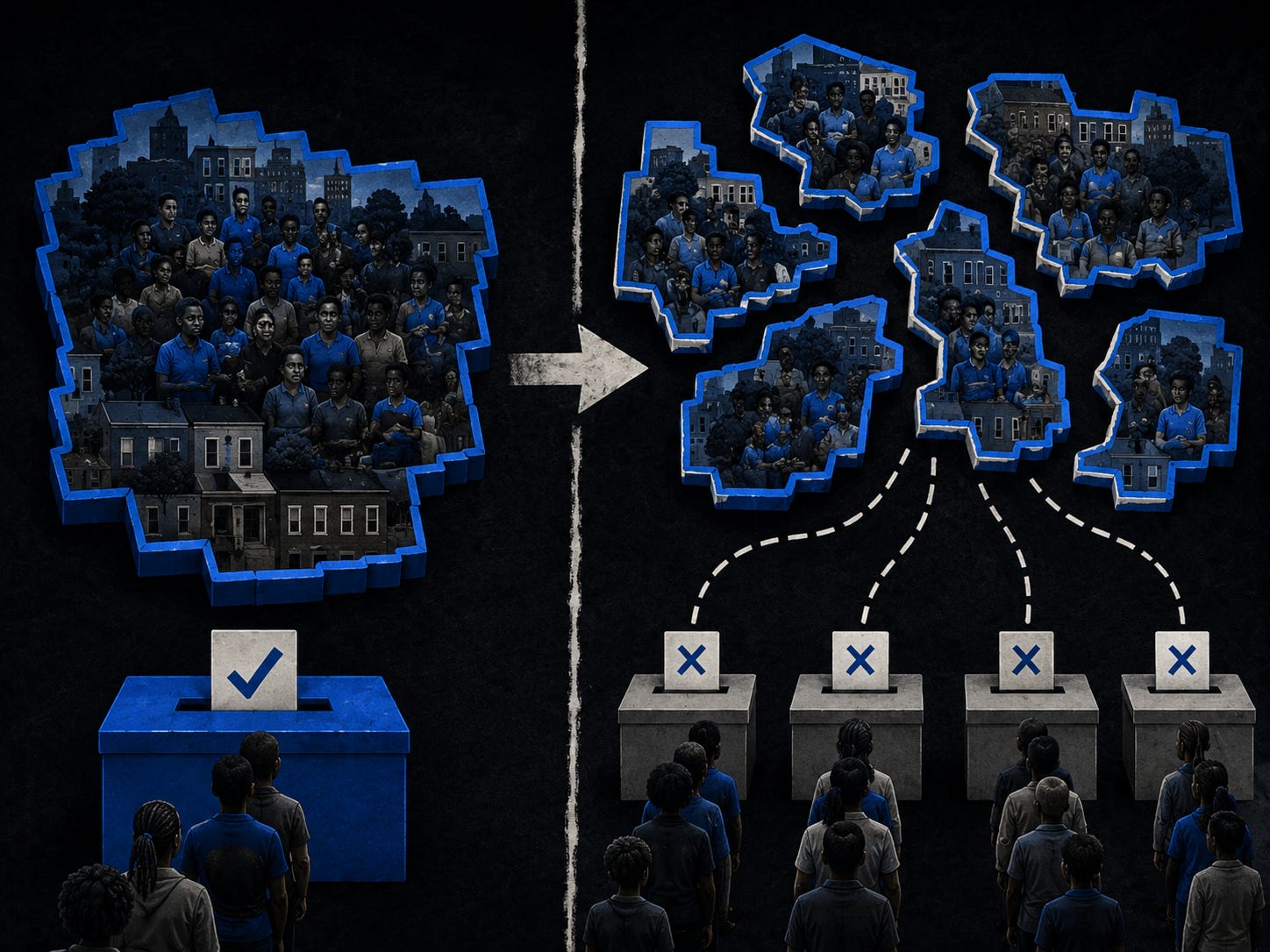
Louisiana has a large Black population, roughly one-third of the state. But without fair district lines, that population can be split, packed, stretched, or sliced in ways that make Black political power smaller than Black presence. That is what vote dilution does. It does not always stop people from voting. It makes sure their votes cannot gather enough power to matter.
That is the trick.
Old voter suppression often stood at the door.
Modern voter suppression draws the room.
It does not always say, “You cannot vote.”
Sometimes it says, “Your vote counts over there, away from everybody else who agrees with you.”
Sometimes it says, “We gave everyone a table, we just made sure your table could never win.”
That is why redistricting matters.
A district map is not just lines on paper. It is the seating chart of political power.
It decides who gets heard together.
It decides whose problems become policy.
It decides whether a community can elect someone who understands its schools, hospitals, roads, policing, housing, jobs, and daily struggles.
When the map is rigged, the outcome is half-decided before Election Day even arrives.
This is why the Supreme Court’s ruling is so dangerous. The Court did not have to say Black people cannot vote. That would be too naked, too old-fashioned, too Jim Crow with the hood still showing.
Instead, it dressed the move in legal language.
Race neutrality.
Districting principles.
Constitutional limits.
Clean words. Dirty effect.
That is how power works when it has learned public relations.
It does not always steal the microphone. Sometimes it rearranges the room so your microphone is pointed at the wall.
The Voting Rights Act was created because America had already proven that paper rights were not enough. The 15th Amendment said Black people had the right to vote. Lovely sentence. Beautiful ink. But for generations, states found ways around it: poll taxes, literacy tests, intimidation, violence, and later, maps drawn with surgical disrespect.
That is why Section 2 mattered.
It gave communities a way to challenge voting systems that diluted their power.
It recognized something Black folks have always known: discrimination does not need to announce itself to be real.
A landlord does not have to say he hates you to neglect your side of the building.
A boss does not have to say he is retaliating to cut your hours.
A politician does not have to say he fears Black voters to draw a map that weakens them.
The harm is in the pattern.
And the pattern is old.
The Campaign Legal Center called this ruling one of the most consequential setbacks for multiracial democracy in a generation, warning that it opens the door for states to enact discriminatory voting maps and laws.
That is the part people need to sit with.
This is not just about Louisiana.
This is a permission slip.
Other states are watching. Other politicians are taking notes. Other mapmakers are learning how to say the quiet part without using the words that get them sued.
Split the voters.
Call it partisan.
Hide the racial impact.
Let the courts bless the paperwork.
Then tell the public democracy is still working because Election Day still happens.
But democracy is not just the act of voting.
Democracy is whether your vote has enough weight to move something.
If your community votes, but the map has already scattered your power, that is not democracy. That is customer service. You got to file a complaint. Nobody had to fix the problem.
Black voting power has always scared the people who confuse control with order.
Because Black voting power changes budgets.
It changes school boards.
It changes judges.
It changes policing.
It changes housing.
It changes who gets a hospital, who gets a bus line, who gets clean water, who gets a grocery store, who gets a polling place, and who gets another speech about patience.
That is why this fight matters.
Not because Section 2 is some sacred legal phrase only lawyers should understand.
Because without real voting power, communities get talked about instead of represented.
They get studied instead of served.
They get managed instead of heard.
They get invited to the reunion, seated in the back, handed a plate, and told to be grateful.
No.
We are past grateful.
The issue is not whether Black people can walk into the room.
The issue is whether the room has been arranged to make our presence meaningless.
That is what the Supreme Court just helped protect.
A rigged seating chart.
A ballot without weight.
A democracy where your vote exists, but your power gets scattered before the count begins.
So the call to action is simple.
Stop treating redistricting like nerd homework.
Watch the maps.
Follow local elections.
Support state voting rights laws.
Pay attention to school boards, city councils, county commissions, and state legislatures.
Back Black-led civic groups doing the unglamorous work before the cameras show up.
Ask candidates where they stand on voting rights before they ask for your vote.
And explain this to somebody who thinks voter suppression only happens at the polling place.
Because sometimes the theft starts earlier.
Sometimes it starts with a map.
Sometimes it starts with a seating chart.
And if we do not organize before the room is arranged, we may spend the next decade voting from the wrong table and wondering why the porch never gets fixed.